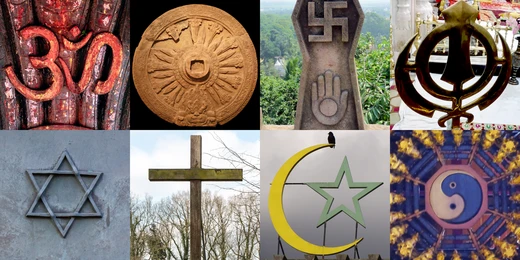
Prayer
Prayer is deliberate communication with a deity or deified ancestor.

Prayer is an invocation or act that seeks to activate a rapport with an object of worship through deliberate communication. In the narrow sense, the term refers to an act of supplication or intercession directed towards a deity or a deified ancestor. More generally, prayer can also have the purpose of giving thanks or praise, and in comparative religion is closely associated with more abstract forms of meditation and with charms or spells. The act of prayer is attested in written sources as early as five thousand years ago, and today most major religions involve prayer in one way or another.
- forms
- hymn, incantation, creedal statement, spontaneous utterance
- associated_practices
- meditation, charms, spells
- common_postures
- standing, sitting, kneeling, prostrate, hands clasped or upraised
- scientific_study_focus
- healing of sick or injured people
Lore & Background
Prayer can take a variety of forms: it can be part of a set liturgy or ritual, and it can be performed alone or in groups. Prayer may take the form of a hymn, incantation, formal creedal statement, or a spontaneous utterance in the praying person. Some traditions distinguish between contemplative and meditative prayer; contemplation is foundational in the Catholic faith, while meditation uses the reasoning faculty to understand revelation. Outward acts that may accompany prayer include anointing with oil, ringing a bell, burning incense or paper, lighting a candle, facing a specific direction, and making the sign of the cross. Fasting is a less noticeable act related to prayer.
Reader's Guide
Prayer has been a central practice across human cultures for at least five thousand years, with written records from ancient Mesopotamia and Egypt. Its forms range from highly ritualized liturgies to spontaneous individual utterances. The efficacy of prayer in faith healing has been evaluated in numerous studies, with contradictory results; many well-controlled trials have found no effect, and some even suggest negative outcomes. Anthropologically, prayer is closely related to surrender and supplication, and in animist traditions, communication with the spirit world is often mediated by shamans. The English term derives from Medieval Latin 'precaria,' meaning petition or prayer. Prayer remains a universal human cultural phenomenon, adapted to the beliefs and practices of each tradition.
Did You Know?
- The English term 'prayer' comes from Medieval Latin 'precaria,' meaning 'petition, prayer.'
- Some of the oldest extant literature, such as the Kesh temple hymn (c. 26th century BC), is liturgy addressed to deities and thus technically 'prayer.'
- Scientific studies on prayer have mostly concentrated on its effect on healing, with contradictory results; many well-controlled trials found no effect.
- In Shinto, prayers frequently consist of wishes or favors asked of the kami, rather than lengthy praises or devotions.
More in Religious Practices And Symbols 1-17
Spotted an error? Know more?
This is a living reference — every entry is fact-audited, and reader corrections feed straight into our audit queue. Suggest an edit · See this site's audit record