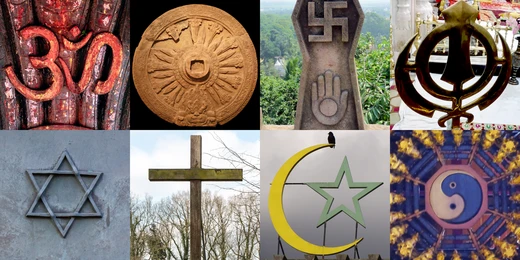
Iconoclasm
Belief in destroying icons for religious or political reasons.

Iconoclasm is the belief in the importance of destroying icons, images, or monuments, often for religious or political reasons. Those who engage in or support iconoclasm are called iconoclasts, a term that has come to be applied figuratively to anyone who challenges cherished beliefs or venerated institutions.
- field
- Religious and political practice
- related_terms
- Iconoclast, iconodule, iconophile, iconolater
Lore & Background
Iconoclasm has ancient roots, with a significant episode in Egypt during the Amarna Period, when Akhenaten ordered the eradication of traditional gods and the destruction of temples and monuments. In Judaism, the Hebrew Bible records God instructing the Israelites to destroy engraved stones and molded images of the Canaanites. King Hezekiah later purged Solomon's Temple and destroyed figures including the Nehushtan.
Reader's Guide
Iconoclasm is significant for its role in shaping religious and political identities across history. In Christianity, periods of aniconism occurred in early Christianity, during the Byzantine Iconoclasm of the eighth century, and in the 16th century when Calvinism rejected all images in churches. The Catholic Church and Lutheran Church defend the use of sacred images. Iconoclasm also appears outside religion, such as the destruction of monarchist symbols during the French Revolution. The practice is more common in religions opposing idolatry, like the Abrahamic religions. Iconoclasm does not generally encompass damnatio memoriae, the destruction of a specific ruler's images after their death.
Did You Know?
- In the Bronze Age, a major iconoclastic episode occurred in Egypt under Akhenaten, who ordered the eradication of traditional gods and destruction of temples.
- King Hezekiah purged Solomon's Temple and destroyed all figures in the Land of Israel, including the Nehushtan.
- The first iconoclastic wave of the Reformation happened in Wittenberg in the early 1520s under Thomas Müntzer and Andreas Karlstadt.
Frequently Asked Questions
What is Iconoclasm?
Iconoclasm is a religious and political practice centered on the deliberate destruction of sacred images, icons, or monuments. It is driven by the conviction that such objects are either theologically inappropriate or politically dangerous, and its practitioners are known as iconoclasts.
What role does Iconoclasm play in religious and political life?
It functions as a tool for enforcing doctrinal purity or asserting state authority over visual culture, making the removal of venerated objects an act of both faith and governance. Its counterpart positions—iconodule, iconophile, and iconolater—represent the opposing camps that defend or revere those same images.
How does the Iconoclasm story end or resolve?
Historically, iconoclast campaigns did not permanently eliminate image veneration; instead, the practice left a lasting legacy of debate over the proper place of visual art in worship. The term has since broadened into everyday language, where an 'iconoclast' can describe anyone who challenges widely held beliefs or institutions.
Why is Iconoclasm important in the study of religious symbols?
It reveals how communities negotiate the boundary between reverence and idolatry, showing that the destruction of an image can be as theologically charged as its creation. Understanding iconoclasm helps explain recurring conflicts over art, authority, and devotion that shape religious identity across traditions.
What is the difference between an iconoclast and an iconolater?
An iconoclast advocates for the removal or destruction of religious images, viewing them as harmful or forbidden, while an iconolater is someone who is accused of treating those images as objects of worship in themselves. The related terms iconodule and iconophile sit between these poles, describing people who venerate or love icons without necessarily crossing into what critics call excessive devotion.
More in Religious Practices And Symbols 1-17
Spotted an error? Know more?
This is a living reference — every entry is fact-audited, and reader corrections feed straight into our audit queue. Suggest an edit · See this site's audit record