Frequently Asked Questions
The most-asked questions about religious practices and symbols.
What is the overall subject of this encyclopedia?
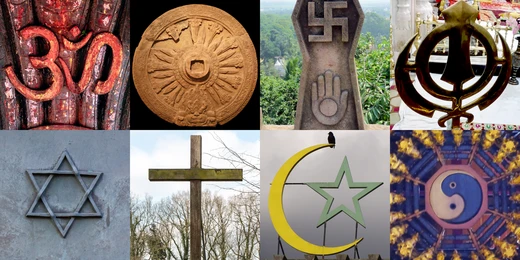
This site catalogs the world's religious practices and sacred symbols across major traditions—Christianity, Islam, Hinduism, Buddhism, Judaism, and many others—treating each symbol, ritual, and figure as a distinct entry to explore.
Who are the central 'figures' a newcomer should know first?
The most widely referenced figures include Jesus, Muhammad, the Buddha, Krishna, Moses, and the various prophets and deities each tradition centers its narrative around. They appear on nearly every symbol entry and practice page, so getting familiar with them early makes the rest of the site far easier to navigate.
Where should a beginner start reading?
Begin with the 'Major Symbols' hub page, which lists the cross, crescent-and-star, Star of David, Om, Dharma wheel, and a few others with one-paragraph explanations. From there, follow the links into individual practice entries like prayer, fasting, or pilgrimage to see how symbols are actually used in daily life.
What are the most universally recognized religious symbols?
The Christian cross, the Islamic crescent, the Jewish Star of David, the Hindu Om, and the Buddhist Dharma wheel are the five that appear most frequently in global art, architecture, and conversation. Each carries layers of meaning that go well beyond a simple logo, and the encyclopedia dedicates a full entry to each.
What kinds of religious practices are covered?
Entries span prayer and meditation, fasting and feasting, pilgrimage and ritual bathing, chanting and hymn-singing, and lifecycle ceremonies such as baptism, bar/bat mitzvahs, and weddings. The site also covers more esoteric practices like yantra drawing, dhikr, and liturgical dance.
How do symbols differ in meaning across traditions?
The same shape can carry very different connotations—for example, the circle represents eternity in Christianity, the cyclical nature of samsara in Hinduism, and the wholeness of the universe in many Indigenous traditions. Each entry includes a 'Cross-Tradition Notes' section to highlight these overlaps and distinctions.
What is a key historical fact about the development of religious symbols?
Most recognizable symbols evolved gradually over centuries rather than being decreed in a single moment; the cross, for instance, was not a Christian emblem until the fourth century, and the Star of David became a Jewish identifier largely in the medieval period. Understanding that timeline helps explain why some symbols feel 'ancient' while others are surprisingly modern.
Are there notable 'moments' or turning points in the history of religious practice?
A few stand out: the Council of Nicaea (325 CE) shaping Christian doctrine and iconography, the Islamic Golden Age spreading geometric calligraphy, the printing press making Bible illustrations standardized, and the 20th-century interfaith dialogues that brought previously isolated practices into global awareness. The 'Timeline' page walks through these in order.
How should I approach symbols from traditions I don't follow?
The encyclopedia encourages context-first reading: learn the theological or philosophical framework behind a symbol before judging its aesthetics. A respectful, inquisitive stance—treating each tradition's own explanations as primary sources—tends to produce the most accurate and nuanced understanding.
Is this site affiliated with any religious organization?
No; it is an independent, fan-maintained reference project with no institutional backing or doctrinal agenda. All entries aim for descriptive accuracy and cite academic sources, but the site does not endorse, promote, or critique any particular faith.